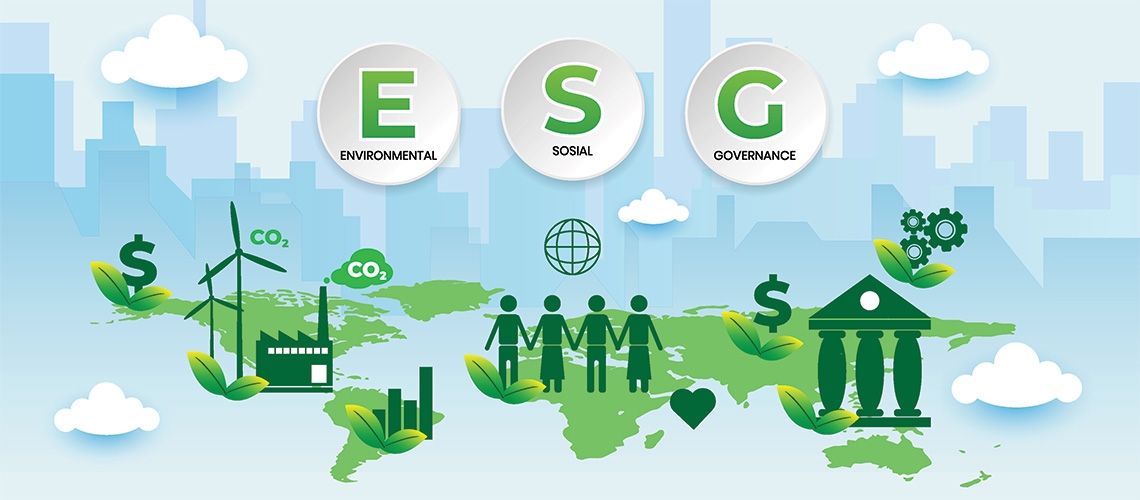

Concept of ESG
ESG is an acronym for Environmental, Social and Governance. The underlying principle behind ESG based investing lies in identifying & quantifying the intangible value possessed by socially responsible, environmentally friendly companies with robust governance policies in place. The term ‘ESG’ was first coined in the year 2004, in the report ‘Who Cares Wins — Connecting Financial Markets to a Changing World’, an outcome of a joint initiative of twenty financial institutions from 9 countries which were invited by United Nations to develop guidelines and recommendations on how to better integrate environmental, social and corporate governance issues in asset management, securities brokerage services and associated research functions. Sustainable investment is an investment approach that considers environmental, social and governance factors in portfolio selection and management.
The aim of ESG investing is to go beyond the financials of the businesses and cultivate an all-inclusive assessment of the company’s operations, management quality and overall impact on society. Accordingly, it is concerned with how companies, apart from their bottom line also manage their ESG risks. An investor may choose to avoid a company which earns high profits but also has higher ESG risk framework – like manufacturing addictive and unhealthy products (cigarettes and alcohol), or poor Environmental risk management (mining and logging). Such companies also face increased risk of being involved in controversies with the government, regulators or other stakeholders. When these risks emerge, the company’s profitability, and shareholder returns are often affected negatively. The investors would therefore prefer to invest in companies managing their ESG risks effectively.
United Nations Principles for Responsible Investment
The United Nations Principles for Responsible Investment (UNPRI) is an international organization that works to promote the incorporation of environmental, social, and corporate governance factors into investment decision-making. The UNPRI defines responsible investment as a strategy and practice to incorporate environmental, social and governance factors in investment decisions and active ownership. The UNPRI works with its international network of signatories to put the six Principles for Responsible Investment into practice . As on the date of this article, there are 4570 signatories to the PRI from over 60 countries, 22 being from India. The following six Principles for Responsible Investment were developed by an international group of institutional investors reflecting the increasing relevance of environmental, social and corporate governance issues to investment practices:
- Principle 1: We will incorporate ESG issues into investment analysis and decision-making processes.
- Principle 2: We will be active owners and incorporate ESG issues into our ownership policies and practices.
- Principle 3: We will seek appropriate disclosure on ESG issues by the entities in which we invest.
- Principle 4: We will promote acceptance and implementation of the Principles within the investment industry.
- Principle 5: We will work together to enhance our effectiveness in implementing the Principles.
- Principle 6: We will each report on our activities and progress towards implementing the Principles.
ESG investing – Global outlook
Intrernationally, the Sustainable and Responsible Investmentment practice is not a new phenomenon. Investors have become aware about the need for investments in the Companies which follow practices which are sustainable and socially responsible. The Global Sustainable Investment Alliance (GSIA) is an international collaboration of membership-based sustainable investment organisations around the world whose mission is to deepen the impact and visibility of sustainable investment organisations at the global level.
GSIA reports on the the status of sustainable investment in the major financial markets globally.
Size, growth and dynamics of the global sustainable investment industry
- At the start of 2020, global sustainable investment assets under management (AUM) reached US$ 35.3 trillion, a 15% increase since the 2018 report (based on assets reported by the United States, EU, Australia/New Zealand, Canada and Japan).
- Global sustainable investment AUM are 35.9% of total assets under management, up from 33.4% in 2018.
- Sustainable investment AUM is largest in the United States with $17.1 trillion, followed by Europe ($12.0 trillion), Japan ($2.9 trillion), Canada ($2.4 trillion) and Australia/New Zealand ($906 billion).
- Sustainable investment assets continued to grow in most regions, with Canada experiencing the largest increase in absolute terms over the past two years (48% growth), followed by the United States (42% growth), Japan (34% growth) and Australia/New Zealand (25% growth) from 2018 to 2020.
- United States and Europe represent more than 80% of global sustainable investing assets.
- The most common sustainable investment strategy is ESG integration, followed by negative screening, corporate engagement and shareholder action, norms-based screening and sustainability-themed investment.
ESG linked loans
The “ESG lending” market, where loan contract terms are contingent on borrower ESG performance (i.e., ESG-linked loans), or where loans are issued for specified green projects (i.e., Green loans), has grown exponentially from $6 billion in 2016 to $173 billion in 2019. ESG-linked loans are issued in sizeable amounts by large and publicly listed borrowers, and are often structured through revolving credit facilities by large groups of syndicates led by reputable “ESG specialist” global banks, who keep tight relationships with borrowers.
ESG investing – Indian outlook
The concept of ESG investing in India in the nascent stage. The investors in India have started to look into the important aspects of socially responsible investing while making investment decisions. India has introduced new environment, social, and governance (ESG) reporting requirements for the top 1,000 listed companies in the country by market capitalization. The Securities and Exchange Board of India (SEBI) stipulates that the disclosure must be made through a new format, namely the Business Responsibility and Sustainability Report (BRSR). BRSR reporting has been made voluntary for FY 2021-22 but will be mandatory from FY 2022-23.
ESG Indices in India
An ESG Index is designed to reflect the performance of companies within its benchmark index, based on Environmental, Social and Governance (ESG) scores. The weight of each constituent in the index is tilted based on ESG score assigned to the company i.e. the constituent weight is derived from its free float market capitalization and ESG score. Major ESG indices in India are:
- S&P BSE Carbonex;
- S&P BSE Greenex and
- S&P BSE 100 ESG
- Nifty100 ESG Index
- Nifty100 Enhanced ESG Index
- Nifty100 ESG Sector Leaders Index
By Deval Pandya